Can AI Be Sustainable? The Climate Cost of Artificial Intelligence - and the Solutions in 2026

Luca Colson & Joshua Feingold
January 6, 2026
Joshua Feingold is a Global Leadership and Peacebuilding Master's student at King’s College London, researching international sustainable development and environmental security in the Global South. He joined The Climate App team as an Analyst in 2025. Luca holds a BA in International Relations from Durham University and is completing an MA at King’s College London. He is a prospective PhD candidate studying multilateral diplomacy at the United Nations.
In short
Artificial intelligence is reshaping daily life, but its environmental cost is rising fast. From carbon emissions to water use, this article explores whether AI can be sustainable - and how sustainable solutions could align AI with climate action.
Can AI be Sustainable?
According to Fei-Fei Li, a professor of computer science at Stanford University, “Artificial intelligence is the future, and the future is here.”. AI has well and truly adopted an everyday role in human life. According to the European Union (EU), 55.03% of EU enterprises use AI systems in their operations in 2025. The British Government has also begun posting its own blogs on the use and regulations of AI, for instance in classrooms throughout the United Kingdom. However, we would be wise to remember the words of the 1921 Nobel Peace Prize laureate, Christian Lous Lange: “Technology is a useful servant but a dangerous master”. Despite AI’s potential to address climate change, an important ethical contradiction remains: can AI truly help humanity overcome the climate crisis if current consequences outweigh future benefits? Whilst the future of AI has the potential to promote the global good, this article considers the conditions under which AI can be deemed ethical in a climate change-affected world and outlines existing solutions available to the public. At The Climate App, we want to show individuals what climate-friendly actions are available to marshal the global transition towards a greener planet.
The Current Unsustainability of AI
AI’s impact on the global climate and environment is two-pronged. First, existing AI companies and systems are producing ever-increasing volumes of greenhouse gas (GHG) emissions, hindering the global drive to achieve net emissions neutrality as rapidly as possible. Second, the development and use of AI requires a significant amount of finite resources, such as fresh water, placing a strain on both the environment and already climate-vulnerable populations.
AI and GHG emissions
As humanity’s reliance on AI systems rapidly increases and AI companies expand their infrastructure, AI-based GHG emissions are anticipated to rise accordingly. According to a study conducted by the Dutch academic, Alex de Vries-Gao, AI-based emissions have reached 80 million tons of CO2 in 2025 alone, a figure higher than New York City’s GHG emissions over the same period. There is no indication that such emissions are close to peaking. On the contrary, states and AI companies have pledged to improve and increase the scale of infrastructure to meet growing needs. For example, Northumberland County Council in the United Kingdom has authorised the construction of a £10 billion data centre in Blyth to be completed by 2035. It is estimated that this data centre alone will emit over 180,000 tons of CO2 per annum, the equivalent of 24,000 homes.
The training of large language models (LLMs) also emits ever-increasing quantities of GHGs, as this training can take up to several months before it can be used. Scholars from the Oxford Internet Institute, University of Oxford, estimated that a single training run for OpenAI's GPT-3 LLM produced over 200 tons of CO2, the equivalent of the yearly emissions by 60 cars, which doesn't seem too much at first, until we understand that models can sometimes have thousands of training runs per year. With the advent of these hyperscale data-centres and powerful LLMs, ethical AI may seem like a far off concept, but there are absolutely strides being made if you look in the right places.
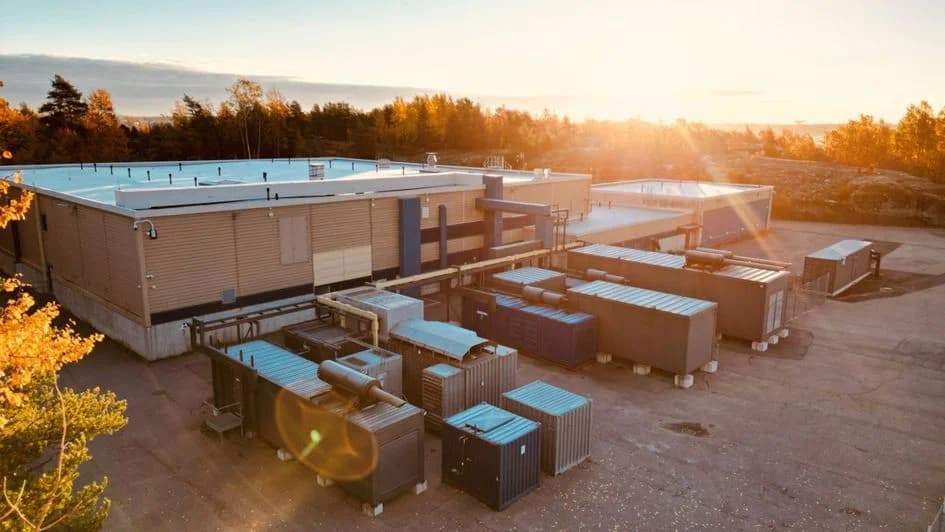
Circular Solutions: Helsinki Data-Centre Heating
Large hyperscale data-centres can generate heat loads between 30-50 MW, equivalent to the power used by 25,000 - 40,000 homes. Finland’s cities have partnered with Google and Microsoft to capture this heat at the source to use in schools, homes, and businesses. In partnerships between AI data-centres and municipal district-heating companies, the heat is injected into the network using heat-pump systems, and credited against the utility’s supply. This sustainable solution produces less carbon and cheaper energy. The Hamina scheme in partnership with Google, is predicted to supply 80% of its annual district-heating demand. The Microsoft data-centre project in Helsinki’s metro area is expected to cover 40% of district-heating demand in the Espoo-Kirkkonummi area – providing heat to approximately 250,000 users. These are readily scalable urban blueprints backed by the globe's biggest tech innovators. The capacity for these circular solutions is bountiful and urging your representative to do their homework can help the process.
Sustainable AI Chat Platforms
Low-carbon and renewably sourced AI Chatbots entered the market in 2025. Here are some of the most high-capacity green models:
1) GreenPT is a GPT-powered chat platform and reliable API running on renewable energy. Its infrastructure is hosted with sustainable providers across Europe and its models reduce computing power by 20-30% without losing quality. GreenPT also offers a real-time CO2 and energy-usage insight bar that you can view in chat. While the initial training of the models wasn’t performed on green servers, their hosting and inference operations are claimed to be 100% sustainable.
2) Ecosia Chat generates more renewable energy than its low-carbon models use. Building upon its popular eco-friendly search engine, 100% of Ecosia’s profits are used for climate action, having planted over 245 million trees and dedicated nearly €100 million to supporting the planet.
3) Viro AI matches the energy of every chat query with clean wind, solar, and battery projects. In sum, Viro AI has funded over 13,000 kWh of clean energy, or 440 homes.
AI Can Be Ethical and the Choice is Ours
AI data-centres have the potential to act as pernicious carbon-emitters and grievous water-wasters. They also have the potential to be integrated into a sustainable and circular system of recycled energy contributing to heating millions of homes and supporting the growth of renewable grid capacity and volume. It depends on how individuals act and how investors frame the AI market. Will you choose renewably sourced AI Chat Bots to come up with a theme for your niece’s birthday party? Is the AI bubble ready to burst? Or is AI the next step to integrating sustainable solutions into communities around the globe?
The rise of AI comes with many notable benefits, but only if it's running and trained on renewable energy. The march of technological advancement must be checked with a reciprocal commitment to use these tools responsibly. The safety of the planet and humanity should be at the forefront of these discussions. The Climate App recommends to choose the green AI providers as mentioned above, and remember to join our newsletter and community!
References
BBC (2025) First phase of data centre works given go-ahead. BBC News. Available at: https://www.bbc.com/news/articles/clyd1enx3p4o (Accessed: 6 January 2026).
Booth, Robert. (2025) Reported in AI boom has caused same CO₂ emissions in 2025 as New York City, report claims. The Guardian, 18 December. Available at: https://www.theguardian.com/technology/2025/dec/18/2025-ai-boom-huge-co2-emissions-use-water-research-finds (Accessed: 6 January 2026).
Cowls, J., Tsamados, A., Taddeo, M., and Floridi L. (2023) 'The AI gambit: leveraging artificial intelligence to combat climate change - opportunities, challenges, and recommendations', AI & Society, 38(1), pp.283-307.
Ecosia (n.d.) Search. Find. Change the World. Available at: https://www.ecosia.org/ (Accessed: 6 January 2026).
Ecosia (2025) The world’s greenest AI is here. Ecosia Blog. Available at: https://blog.ecosia.org/ecosia-ai/ (Accessed: 6 January 2026).
Eurostat (n.d.) Use of artificial intelligence in enterprises. European Union. Available at: https://ec.europa.eu/eurostat/statistics-explained/index.php?title=Use_of_artificial_intelligence_in_enterprises (Accessed: 6 January 2026).
GOV.UK (2025) AI in schools and colleges: what you need to know. Education Hub Blog. Available at: https://educationhub.blog.gov.uk/2025/06/artificial-intelligence-in-schools-everything-you-need-to-know/ (Accessed: 6 January 2026).
GreenPT (n.d.) Sustainable and privacy friendly AI. Available at: https://greenpt.ai/ (Accessed: 6 January 2026).
Lange, C.L. (1921) Nobel Peace Prize lecture. The Nobel Prize. Available at: https://www.nobelprize.org/prizes/peace/1921/lange/lecture/ (Accessed: 6 January 2026).
Livemore, C. (2025) Case study: How Finland is turning excess heat from data centres into neighbourhood heating programmes. Creating Sustainable Cities. Available at: https://www.creatingsustainablecities.org.uk/post/case-study-how-finland-is-turning-excess-heat-from-data-centres-into-neighbourhood-heating-programm (Accessed: 6 January 2026).
Meier, J.D. (n.d.) AI quotes: Insightful perspectives on the future of intelligence. Available at: https://jdmeier.com/ai-quotes/ (Accessed: 6 January 2026).
Verne Global (2024) Harnessing data center waste heat. Available at: https://www.verneglobal.com/blog/data-center-waste-heat (Accessed: 6 January 2026).
Viro (n.d.) Viro AI – Eco-friendly ChatGPT alternative. Available at: https://ai.viro.app/ (Accessed: 6 January 2026).
van Wynsberghe, A. (2021) ‘Sustainable AI: AI for sustainability and the sustainability of AI’, AI & Ethics, 1(3), pp. 215–224.
Image
https://www.helen.fi/en/news/2024/more-Helsinki-homes-to-be-heated-using-excess-heat-from-Equinix-data-centers
Explore More

Take Climate Action
Simple, practical ways to reduce your carbon footprint, alone or with others.
10 Highest-Impact Climate Actions
The personal actions that make the biggest measurable difference, backed by science.

Join the Climate Action Movement
How individual actions add up to collective, global change.