Plug In Solar Panels and UK Energy Bills

Max Cromie
June 7, 2026
Max is an MSc Environment, Politics and Society student at UCL with a BSc in Geography and a strong interest in climate solutions, sustainability, and environmental policy. Max has experience in environmental research, sustainability initiatives, and climate-focused projects, and alongside his studies, he competes internationally as a Great Britain athlete in fencing.
In short
On 24 March 2026, the UK Government announced that energy-generating plug‑in solar panels would be available for purchase through UK supermarkets and retailers.
On 24 March 2026, the UK Government announced that energy-generating plug‑in solar panels would be available for purchase through UK supermarkets and retailers. This will enable households to generate a portion of their own electricity and potentially reduce energy bills.
The announcement, released by the Department for Energy Security and Net Zero, reflects the government’s continued push towards clean, home‑grown power and reducing the UK’s exposure to volatile fossil fuel markets. This policy direction has gained greater prominence amid ongoing global geopolitical instability.
This development comes alongside wider changes in housing standards. Under the Future Homes Standard, new‑build homes in England will be fitted with solar panels and low‑carbon heating technologies, such as heat pumps, from 2028 onwards. Together, these policies signal a broader shift towards lower‑carbon energy across the UK housing sector.
To support accessibility, plug‑in solar panels have been described as low‑cost, with the intention of making small‑scale solar generation available to a wider range of households.
How Do Plug‑In Solar Panels Work?
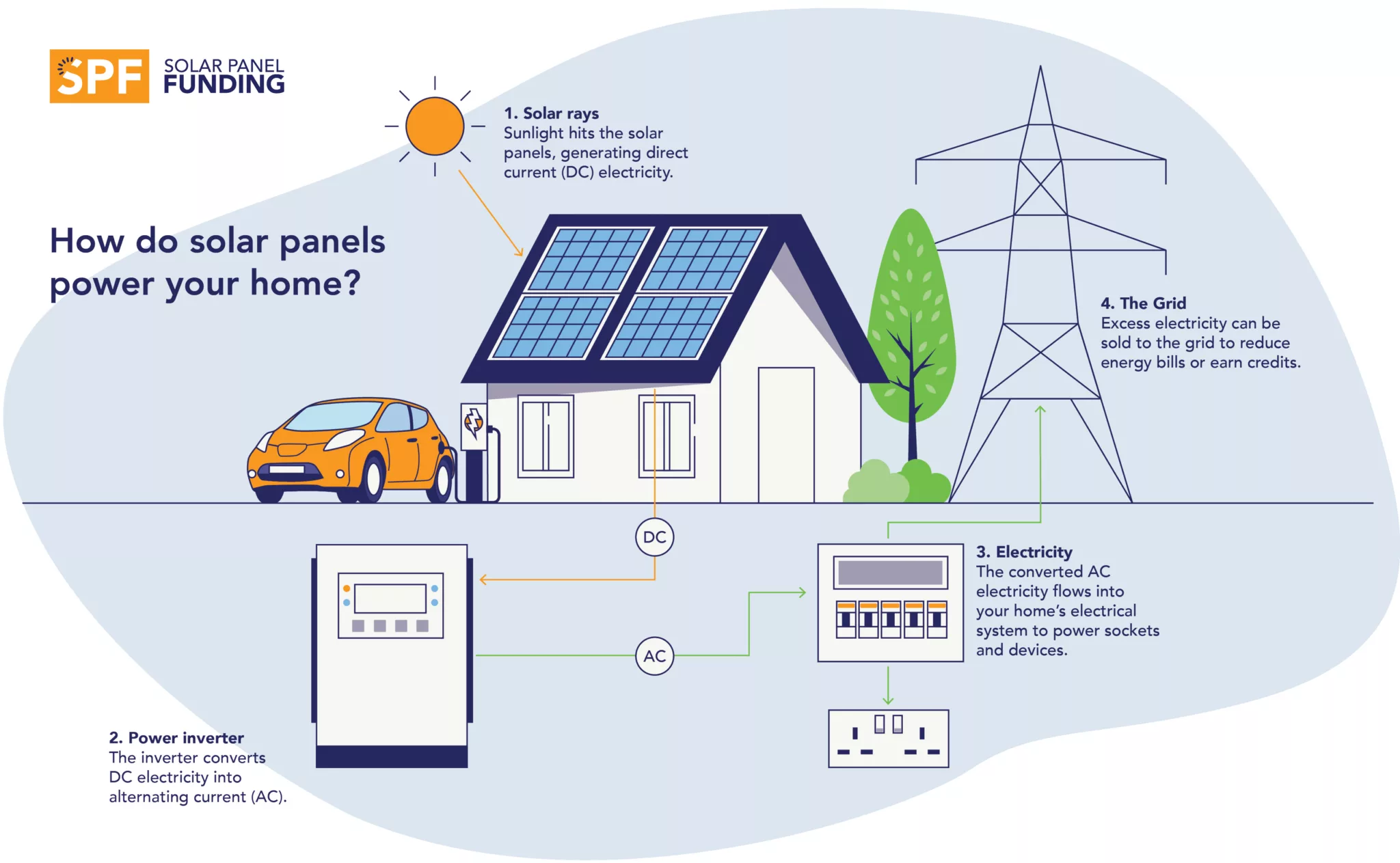
Plug‑in solar panels operate using the same basic principle as conventional rooftop solar systems. Solar photovoltaic (PV) cells absorb energy from daylight, generating electricity. This electricity is then supplied to household appliances via the home’s electrical system.
One key difference is scale and simplicity. Standard solar panels generate electricity as direct current (DC), while homes operate on alternating current (AC). As a result, a solar installation requires an inverter to convert DC into usable AC power.
Plug‑in solar systems include a micro‑inverter within the unit itself, which performs this conversion automatically. This makes the system simpler to install and operate, without the need for a professionally installed inverter or extensive wiring.
In simple terms:
- Sunlight hits the panel
- The panel generates electricity
- The micro‑inverter converts the power
Electricity is used in the home before additional power is drawn from the grid
Source: Solar Panel Funding
Is the Technology Proven?
YES. Plug‑in solar panels are already widely used across parts of Europe. In Germany, for example, around half a million plug‑in solar devices are installed each year, demonstrating both technical viability and public uptake.
What If I Don’t Have a Roof?
One of the key advantages of plug‑in systems is flexibility. According to GOV.UK:
“The portable, plug‑in solar panels can be placed in gardens or on walls and balconies – providing a new, simple alternative for renters and flat owners who may not have the option of rooftop solar.”
This makes plug‑in solar particularly relevant for renters and apartment dwellers who are typically excluded from rooftop solar installations.
Who Is Supporting the Initiative?
The proposal has received support from a range of stakeholders across the UK energy and sustainability sectors. Organisations expressing support include Octopus Energy, E.ON UK, Centrica, EDF, Solar Energy UK, HPA UK, and the Sustainable Energy Association (SEA), among others.
How Can Plug‑In Solar Panels Reduce Energy Bills?
Electricity generated by plug‑in solar panels can be used directly through a standard mains socket, reducing the amount of electricity a household needs to draw from the grid. As a result, overall electricity costs may be reduced.
Beyond household savings, increased uptake of small‑scale solar generation could also contribute to reducing the UK’s reliance on imported fossil fuels, supporting greater energy security and resilience.
Plug‑In Solar Panels vs Traditional Solar Panels
The main difference between plug‑in solar panels and conventional rooftop systems is size, output, and cost.
A typical domestic rooftop solar system produces around 3.5 kWp and costs approximately £6,100. In contrast, plug‑in systems generally produce under 800 W and are expected to cost significantly less, current estimates suggest around £400, though actual prices may vary.
Based on this estimate, households could save approximately £70–£110 per year on electricity bills. At this rate, the system could pay for itself within around four years, with any additional electricity generated thereafter effectively free.
The Future Homes Standard and Long‑Term Savings
Under the Future Homes Standard, new‑build homes are expected to be significantly cheaper to run. Government estimates suggest energy bill savings of up to £830 per year compared to a standard home with an Energy Performance Certificate (EPC) rating of C.
Homes built under the new standard are expected to produce at least 75% fewer carbon emissions than those built to 2013 standards. Notably, these homes will no longer be connected to the gas grid, instead relying on heat pumps or heat networks.
Solar panels fitted to new homes will be required to cover an area equivalent to 40% of the ground‑floor footprint. While this is expected to increase construction costs by around £10,000 per home, the long‑term reduction in running costs is expected to benefit occupants.
At present, battery storage is not mandated. However, combining solar panels with battery storage can further reduce reliance on grid electricity and increase household resilience.
What If I Want Full Rooftop Solar Instead - or as Well?
Domestic rooftop solar systems vary in cost depending on:
- The size of the system
- Roof access and complexity
- Panel versus solar tile choice
- Whether panels are integrated into the building
- Whether roof coverings require replacement
Ground‑mounted systems vary further depending on mounting type and distance from the property.
What Is a Solar Diverter?
A solar diverter allows excess solar electricity to be redirected to heat water in a hot water tank for later use. Installation typically costs around £800, and diverters generally require replacement after approximately 12 years.
Installers may also recommend expanding the size of a solar system to ensure sufficient electricity generation for hot water needs.
Are There Solar Grants Available?
There are currently no dedicated UK government grants specifically for solar panels. However, funding may be available through broader energy efficiency schemes:
- .
Households are advised to contact their energy supplier for up‑to‑date support options.
Is Solar Energy Increasing?
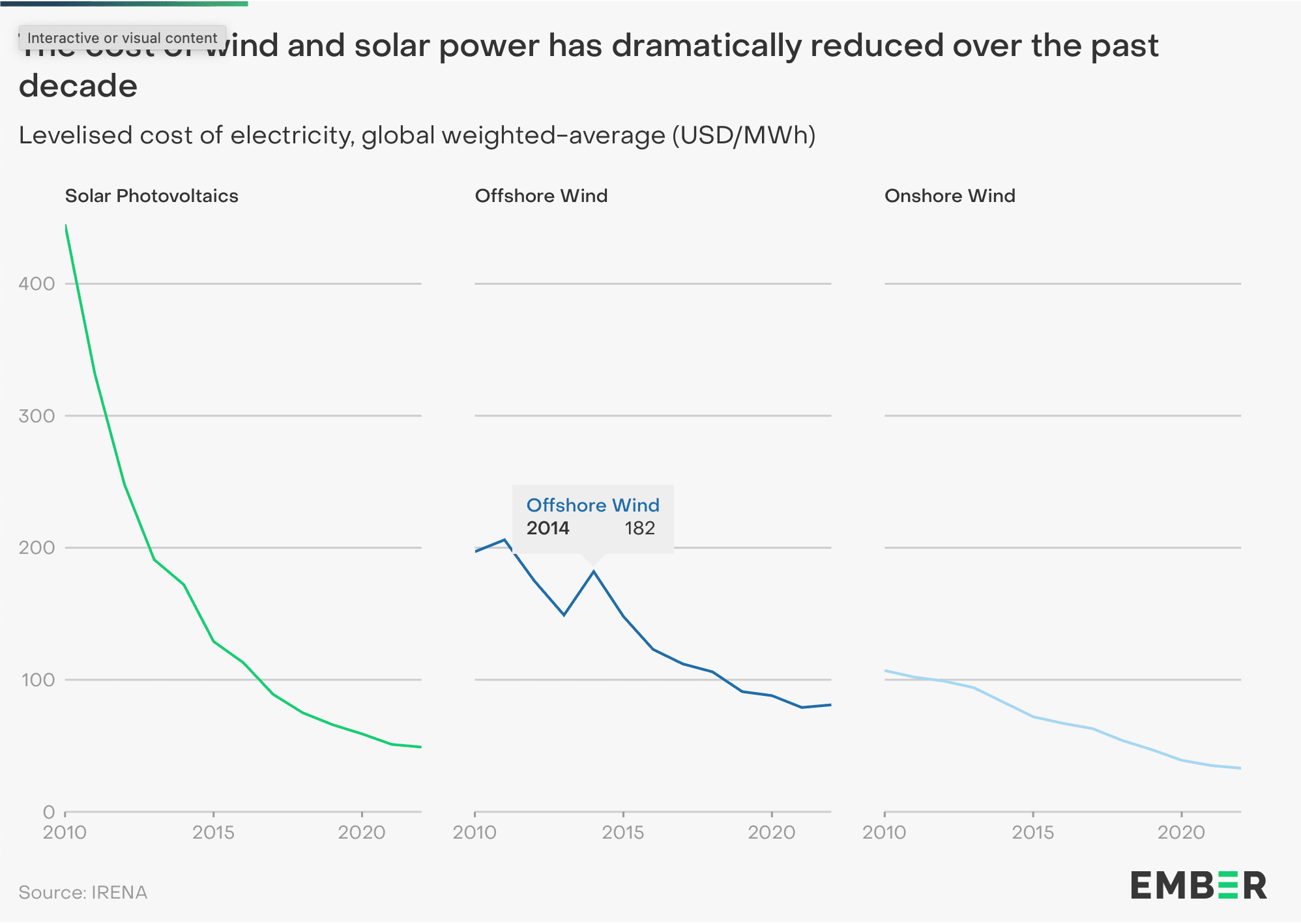
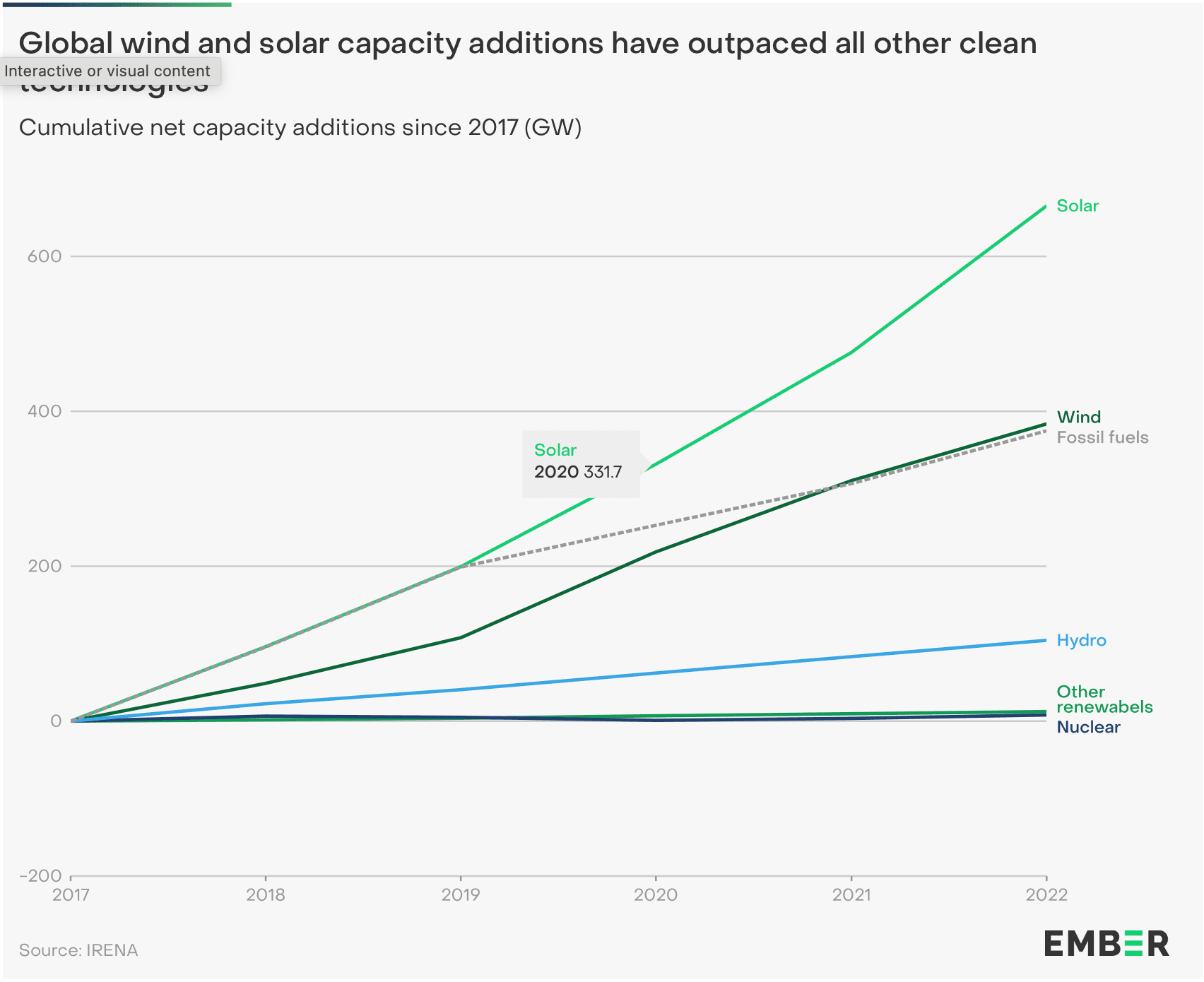
Globally, both wind and solar power have become cheaper, faster to deploy, and more scalable over the past decade. Decarbonising the power sector is widely viewed as one of the most cost‑effective steps towards reducing global emissions.
Solar and wind technologies are well‑established, rapidly deployable, and among the least carbon‑intensive sources of electricity. Their continued expansion plays a central role in broader efforts to limit global warming and transition energy systems away from fossil fuels.
Source: Ember Energy
Source: Ember Energy
References:
ENPHASE. (n.d.). What is a Microinverter? Retrieved April 2026, from ENPHASE: https://support.enphase.com/s/article/What-is-a-Microinverter
Gibbs, J., & O'Loan, J. (n.d.). Renewable energy generation Solar panels Lower your electricity bills with free energy from the sun. Retrieved April 2026, from energy saving trust: https://energysavingtrust.org.uk/advice/solar-panels/
GOV UK. (2026, March 15th). Government to go "further and faster" in becoming energy secure. Retrieved from GOV.UK: https://www.gov.uk/government/news/government-to-go-further-and-faster-in-becoming-energy-secure
GOV UK. (2026, March 24th). Government to make 'plug-in solar' available within months. Retrieved from GOV.UK: https://www.gov.uk/government/news/government-to-make-plug-in-solar-available-within-months
Petrakos, K. (2026, March 30th). Plug-in solar panels could save you £100 – but this is who should buy one. Retrieved from The I Paper: Plug-in solar panels could save you £100 – but this is who should buy one
Potentia Engineering. (n.d.). What are Solar Diverters? – Cost and Benefits. Retrieved April 2026, from Potentia Engineering: https://potentia-engineering.co.uk/articles/what-are-solar-diverters-cost-and-benefits/
Siobhan. (2026, March 24th). Plug In Solar Panels UK: Are They Worth It, or Should You Install a Full Solar Panel System? Retrieved from Solar Panel Funding: https://www.solarpanelfunding.co.uk/plug-in-solar-panels-uk/#:~:text=The%20government's%20planned%20plug%2Din,cheap%20because%20it%20is%20tiny
Stallard, E., & Rowlatt, J. (2026, March 24th). Heat pumps for all new homes and plug-in solar in green tech drive. Retrieved from BBC News: https://www.bbc.co.uk/news/articles/czjw7klkjm2o
Williams, R. (n.d.). Energy performance certificates (EPCs) explained. Retrieved April 2026, from Energy Saving Trust: https://energysavingtrust.org.uk/advice/guide-to-energy-performance-certificates-epcs/
Explore More

Take Climate Action
Simple, practical ways to reduce your carbon footprint, alone or with others.
10 Highest-Impact Climate Actions
The personal actions that make the biggest measurable difference, backed by science.

Join the Climate Action Movement
How individual actions add up to collective, global change.