The Leadership of Christiana Figueres: Creating the “Clumsy Solutions” to Climate Change

Josh Feingold
December 30, 2025
Josh is the Sustainable Impact Analyst at The Climate App. He is a Global Leadership and Peacebuilding Master's student at King’s College London where he investigates the nexus of international sustainable development and environmental security policy in the Global South. He joined The Climate App team in 2025.
In short
Following the oft-opined failure of Copenhagen climate negotiations in 2009, Christiana Figueres was selected as General Secretary of the United Nations Framework Convention on Climate Change (UNFCCC).
Christiana Figueres’ Rise to General Secretary of the United Nations Framework Convention on Climate Change
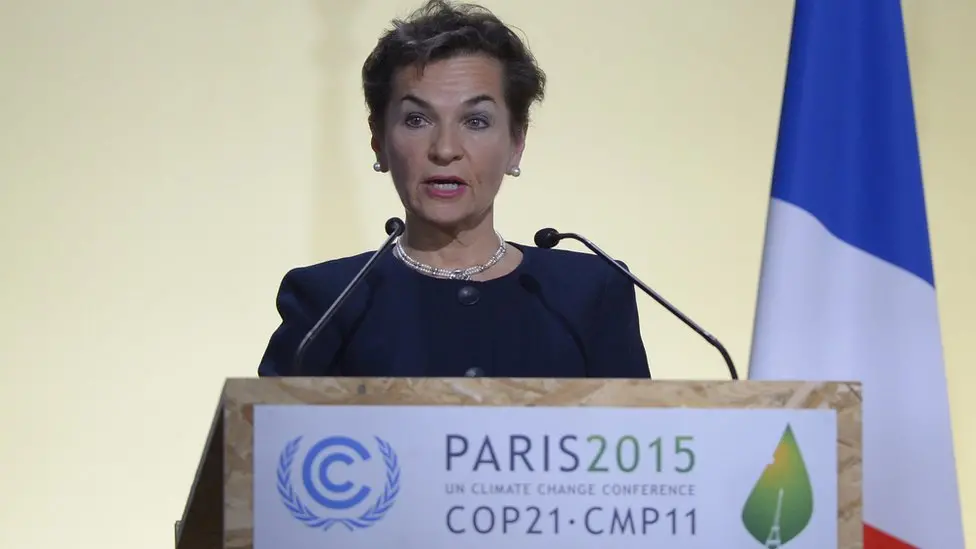
Following the oft-opined failure of Copenhagen climate negotiations in 2009, Christiana Figueres was selected as General Secretary of the United Nations Framework Convention on Climate Change (UNFCCC). She would go on as a crucial element to the successful mediation and adoption by 194 states and the European Union of the Paris Agreement at the UN Climate Change Conference (COP 21). The Paris Agreement is a legally binding international treaty, entering into force on 4 November 2016. Among its key goals, it sets out to reduce global greenhouse gas emissions (GHGs) to maintain a global temperature increase to below 2°C (United Nations, “The Paris Agreement”). The Paris Agreement remains intact to present-day.
Before her role as General Secretary, Figueres worked in the public service of Costa Rica as a diplomat, Director of International Cooperation in the Ministry of Planning in Costa Rica, and Chief of Staff to the Minister of Agriculture. In 1995, she founded the Centre for Sustainable Development of the Americas, a non-profit focusing on climate change policy and capacity-building, which she directed from its nascency to 2003. From 1995, she has been involved in climate change negotiations in varying facets: a member of Costa Rica’s negotiation team, a member of the Executive Board of the Clean Development Mechanism, and has served as Vice President of the Bureau of the Conference of the Parties (United Nations Framework Convention on Climate Change, “Former Executive Secretary: Ms. Christiana Figueres”). Her vast array of experiences illuminated her as a proven leader capable of reshaping global consensus toward a steadier path of climate recovery.
A Family of Transformational Leaders
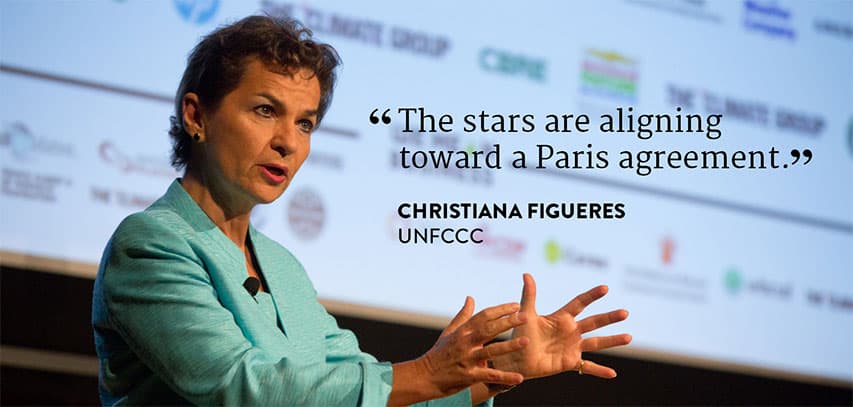
General Secretary Figueres’ father, José Figueres Ferrer, was the president of Costa Rica in three periods from 1948-49, 1953-58, and 1970-74. He, like his daughter, was a transformational leader who ushered in an age of humanist policy that would reshape his native Costa Rica into an economically prosperous, socially progressive, and democratic nation (Municipality of Desamparados, “José Figueres Ferrer”). In his first term, he led the country to: abolish the Costa Rican army; instate a constitution; nationalise the banking sector; and granted women and Black people the right to vote (MIT Alumni Association, “MIT’s Costa Rican President”).
Christiana Figueres saw her country transform under the unifying leadership of her father. She brought with her to the UNFCCC a critical comprehension of what collective, transformational leadership looks like in practice.
Transformational Leadership Starts Within
In transitioning from a national diplomatic perspective to an international mediation role, she recognized that she too needed to transform in order to bring about collective agreement. Further, Figueres transcended her own self-interests to pursue a cause that is more than her, or any individual. In conversation with the Oxford Climate Journalism Network, Figueres stated that in creating change, one must transcend their internal struggle, and transmute it toward positive action.
“[Changemakers] first have to look at our interior world to figure out where [changemakers] are on this …Where is my pain? … The magic here is to take that and change it around and be able to derive the power from the pain … precisely because of that pain and because of the anger, [Figueres is] going back out and I’m going to fight the good fight. It’s the most transformational experience that we can have for ourselves, and the best way that we can prepare ourselves to have more impact.” (Christiana Figueres, “Keep Things Simple and Cut the Blame: Five Lessons from Christiana Figueres on Covering Climate Change,” Reuters Institute for the Study of Journalism, University of Oxford)
Figueres transcends in the vein of “transmutation” converting the strife of the climate crisis into actionable tasks; these are methodical steps toward bettering the situation - not lofty goals. Bass and Riggio proposed an adjustment to Maslow’s Hierarchy of Needs in the context of transformational leadership, traversing one’s own interiority beyond self-realization, to reach a stage they call “idealization”, pursuing a cause greater than oneself. Figueres is describing the praxis of this theory. In order to transform the culture around you, to enact change, one must first change themselves.
As a transformational leader, Figueres needed to align the followers' self-interests with the interests of greater humanity (Bernard M. Bass and Ronald E. Riggio, Transformational Leadership (New York: Taylor & Francis Group, 2005)). To duly fulfil that role, she underwent intense self-examination and converted her mindset from one that had been formerly in practice as an agent of Costa Rica, to one that acted as an agent of the world.
While the Paris Agreement was formally negotiated in a period of two weeks, it took years and consistent communication with world leaders leading up to it for Figueres to execute the diplomatic efforts leading to an agreement jointly signed by 195 parties in those crucial two weeks. Figueres acted as a key architect in forming a global consensus and emerged as a visionary transformational leader who emphasized collective responsibility and adaptability in unifying these disparate bodies, each with their own goals and inhibitions regarding the treaty.
Christiana Figueres’ ‘Outrage and Optimism’ Podcast: The Self-Proclaimed Stubborn Optimist
Figueres’ hosts the Outrage and Optimism podcast as part of her thought-leadership organization Global Optimism. She is flanked by co-hosts Tom Rivett-Carnac, a former Buddhist monk and fellow at Stanford Law School, and Paul Dickinson, a noted climate economist and sustainability expert helping bring about transparent environmental performance business reports in 80 countries. The trio brings in noted environmental experts and change-makers, such as David Attenborough and Greta Thunberg, to discuss the road to net-zero.
Figueres' penchant optimistic streak is rooted in a conscientious understanding of the circumstance – it is a choice grounded in the facts. In an interview with Fair Planet, she demonstrates where this optimism comes from.
“For me, optimism cannot be blind or naïve. It’s not a sense of ignoring the science…It’s also not an irresponsible optimism, in the sense of saying, ‘Well, this is for someone else to deal with, and I’ll just sit here on the couch and delegate the responsibility. For me, optimism is a well-informed, deeply in-touch choice that we make to transform the pain into conviction and agency. It is not the output of something we have achieved–it is the input.” (THE POWER OF OPTIMISM: A CONVERSATION WITH CHRISTIANA FIGUERES)
While there are active participants within the environmentalist community who claim there are folks with a pernicious, toxic sense of optimism that only creates a misleading veneer over the real issues, there is also optimism that works, both for the cause and for other community members. The optimism that Figueres explains catalyzes followers to become passionate about the work. It supercharges and galvanizes communities to come together to face the reality of fossil fuel dominance in the market, in lobbying, and in multilateral trade negotiation. Figueres is optimistic while knowing all of the facts, while doing the work. It will not bring her down. She calls it a “stubborn optimism”. This is the kind of leadership necessary to continue the work when the protest is over and the picket signs are stored in the attic.
Framework Theory for Leadership Analysis: Grint’s “Wicked Problems & Clumsy Solutions”
While more process-based institutional frameworks such as House’s Path-Goal theory may be of use in the context of formulating solutions to the Wicked Problem of climate change, what worked and what is needed is not elegant nor simple (Robert J. House, “A Path-Goal Theory of Leader Effectiveness”, Chester A. Schriesheim and Linda L. Neider, “Path-Goal Leadership Theory: The Long and Winding Road”). Keith Grint’s “Wicked problems and clumsy solutions: The role of leadership” offers critical structures and guidance in approaching the daunting complexity of multi-party, multi-faceted global challenges. Grint’s “Clumsy Solutions” framework may be suited for unifying the world to adopt a singular, yet varied, collective response to climate change (Keith Grint, “Wicked Problems and Clumsy Solutions: The Role of Leadership”). Grint emphasised the need for accepting ambiguity, imperfection, and the importance of problem framing in addressing wicked problems.
The concept of “wicked problems” was first formulated by Rittel and Webber and has since been used to characterise issues such as poverty, food security, terrorism, and most prescient to this analysis, climate change. Wicked problems are complex policy issues with dire consequences for society (Policy and Society 36). These problems are unable to be solved using conventional methods because of their non-linear internal dynamics, influenced by multiple potential causes. The intrinsic difficulty of managing solutions to these issues can be multiplied by their inherent lack of central authority in solution-building, especially in the case of multi-state or global issues such as climate change. These issues are further exacerbated by the time running out for amelioration (Horst W. J. Rittel and Melvin M. Webber, “Dilemmas in a General Theory of Planning”).
Climate change poses the ultimate wicked problem of the 21st century. In order to adequately address it, a collective patchwork response needed to take shape.
Figueres as Lévi-Strauss’ “Bricoleur” in Leading COP-21 Negotiations
General Secretary Figueres embodied the schema of Grint’s reference to Lévi-Strauss’ “bricoleur”. The bricoleur is someone who makes “progress by stitching together whatever is at hand, whatever needs to be stitched together, to ensure practical success” (Claude Lévi-Strauss, The Savage Mind, Keith Grint, “Wicked Problems and Clumsy Solutions: The Role of Leadership”). Grint’s Clumsy Solution theory postulates that the leaders best suited to address wicked problems acknowledge they do not have the answer. Instead, leaders must engage the community of followers to collectively formulate solutions unique to the situation. This requires a mosaic of solutions adhered together with good-faith intention and reciprocal interest between state and the greater UNFCCC goals. Indeed, Figueres exhibited the visionary outlook a global response required, and also supplemented the vision with a commitment to a new strategic path forward and the practical processes of planning and shaping the vision to develop solutions for an imperfect problem (Nada Kakabadse, Andrew Kakabadse, Linda Lee-Davies, Visioning the Pathway:: A Leadership Process Model).
In the context of COP-21, these practical adjustments took form in part through the implementation of the newly formulated Nationally Determined Contributions (NDCs) as a means for states to independently submit their goals for climate action to the UNFCCC secretariat every five years starting in 2020 (United Nations Framework Convention on Climate Change, “Nationally Determined Contributions (NDCs)”). The implementation of NDCs arose from the ineffective climate commitments institutionalized as part of the 1997 Kyoto Protocol. These commitments omitted major emitters and divided responsibilities between developed countries and developing countries. Instead, NDCs apply to every party and consider concerns individual to each party’s ability (World Economic Forum, “COP29, NDCs, and Why They Matter”). The unanimous acceptance of this major shift reflects the necessity to heed the autonomy of every state, avoid alienating certain constituencies, and take on the collective responsibility essential for multi-party negotiations to succeed.
Conclusion: Reciprocity in Transformational Leader-Follower Dynamic
General Secretary Figueres cultivated a framework which championed state sovereignty and fostered a pragmatic approach devised from years of experience and reflection. This trial and error process coincided with her trademark stubborn and optimistic commitment to ushering in collaborative mutuality under a common goal to reduce GHGs (Global Optimism, “Why Stubborn Optimism”). She acted as a force to galvanize parties toward action, released blame for the failures of COP-15, and actively went about pursuing remedies for the failed trials of the past.
The success of the Paris Agreement could not have come about without the presence of followers. To effectively follow, followers must transcend their own personal or national allegiances. By reframing the issue of climate change to see group-based progress as individual progress, all parties were able to commit to conjoint efforts toward the same mission (Ronald E. Riggio, Ira Chaleff, and Jean Lipman-Blumen, eds., The Art of Followership: How Great Followers Create Great Leaders and Organizations). Followers recognized the good will of Figueres and other organizers’ transformational leadership and in turn were reciprocally granted the individualized consideration lacking in the Kyoto Protocol. The transformation of the global climate action outlook took root with presence on all sides, assured individual accountability, and a transparency grounded in mutual responsibility for the security of the earth and its inhabitants.
Image Sources: (BBC, CO2.Earth)
Explore More
Take Climate Action
Simple, practical ways to reduce your carbon footprint, alone or with others.

10 Highest-Impact Climate Actions
The personal actions that make the biggest measurable difference, backed by science.

Join the Climate Action Movement
How individual actions add up to collective, global change.