We Built the Lifeboats in the Path of the Storm: The Protection Paradox of Marine Protected Areas

Neha Ghosh
September 20, 2026
Neha is a Masters Graduate from the University of Southampton, where she studied Natural Sciences, and is eventually hoping to do a PhD. By being able to study a variety of modules she has learnt to approach questions with an interdisciplinary mindset; fundamental for tackling the climate crisis. She is particularly interested in the intersection between the climate crisis, how it informs policy, and especially how it affects human rights in poverty-stricken countries. Eventually, she is hoping to sit on those panels that will help to inform change, and is hence passionate about inspiring action to the wider community through the Climate App.
Somewhere off a tropical coast, inside an invisible line on a map, with no fishermen dragging trawlers to catch rare fish, or miners drilling for rare metals along the seafloor, a reef is doing exactly what we asked of it. This is a marine protected area (MPA) and it is one of humanity's better ideas. We looked at the parts of the sea that matter most, parts that host the greatest biodiversity, and chose to guard them.
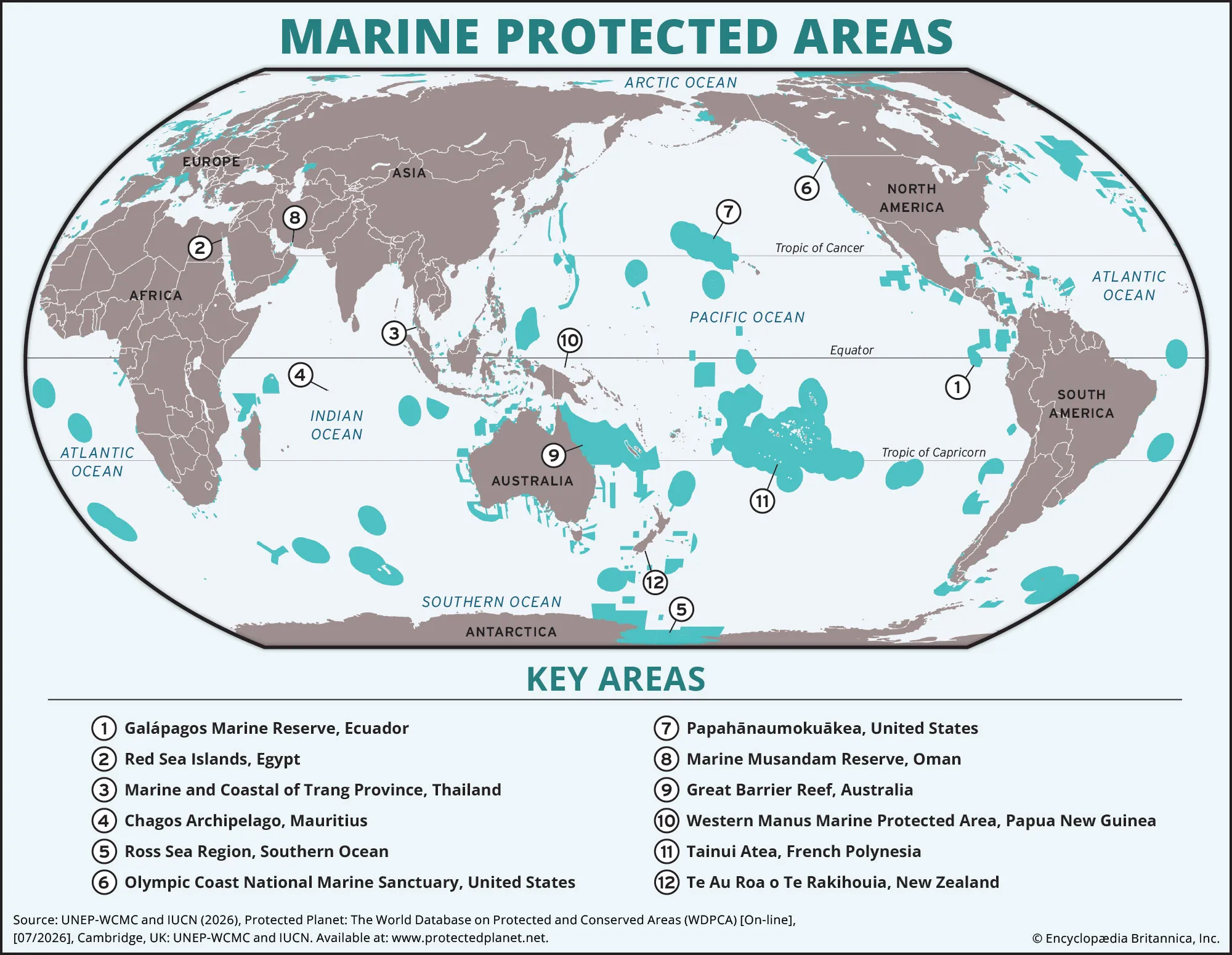
We’ve employed MPA systems well; around 8% of the global ocean now sits inside some form of protection (see Fig. 1), and there’s seemingly a thirst for even greater improvement. This is shown by a recent YourGov survey, stating that 81% people believe nature to be continuously under threat and deserving of stronger defence.
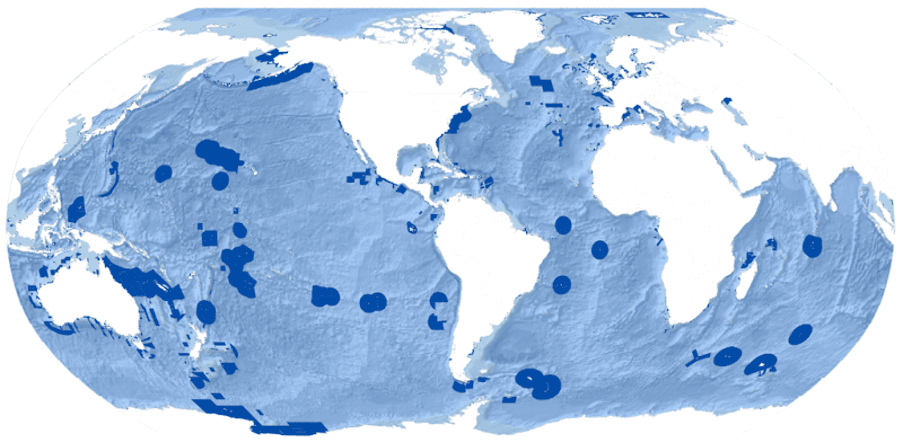
Fig. 1. The world's marine protected areas, displayed in dark blue.
A wall with no roof
But warming doesn't respect boundaries. We can ban the fishing boats and clean up the pollution as aggressively as possible, but a protected area has no power over the temperature of its own water. That is determined by Climate Change and global warming.
What have we achieved? We've built sanctuaries with strong walls and no roof against the sky.
The scale of that heat is hard to feel in the abstract, so let’s quantify it. The oceans have absorbed roughly 90% of all the extra warmth our emissions have trapped. The sea surface is already roughly 1°C warmer than before the industrial age, with two-thirds of it happening in the last 40 years. Under a high-emissions future, the water within protected areas could get warmer by a further 4°C by 2100. For animals that have evolved over millions of years to develop varying levels of tolerances, that is the difference between life and death.
The cruel twist
By protecting these places so well, we have cornered the very species least able to survive what is coming and restricted them into hot pockets. A good MPA lets vulnerable, heat-sensitive life recover and flourish: we concentrate biodiversity precisely where we can shelter it from nets and dredges. But we cannot shelter it from temperature, and this so-called sanctuary transforms into a trap.
This raises a stark question: at what point does a reserve become too hot for the very life it protects? The answer depends almost entirely on how much carbon us humans decide to emit.
On a low-emissions path, the damage stays contained: by 2100, the typical reserve loses only around 10% of its species to heat (Fig. 2a). While on an intermediate path, those figures roughly double (Fig. 2b), on a high-emissions path - the one we are currently on based off of our actions and current policies - the picture collapses. By 2100, close to half of resident species in the average protected area could be pushed beyond their survival tolerance (Fig. 2c). In roughly one in four MPAs, every single species the reserve was created to protect could be pushed to their inevitable fate (Fig. 3). For many tropical reserves, this isn't a consequence in some distant century, but has begun within this decade and will likely peak within the lifetime of most people reading this blog.
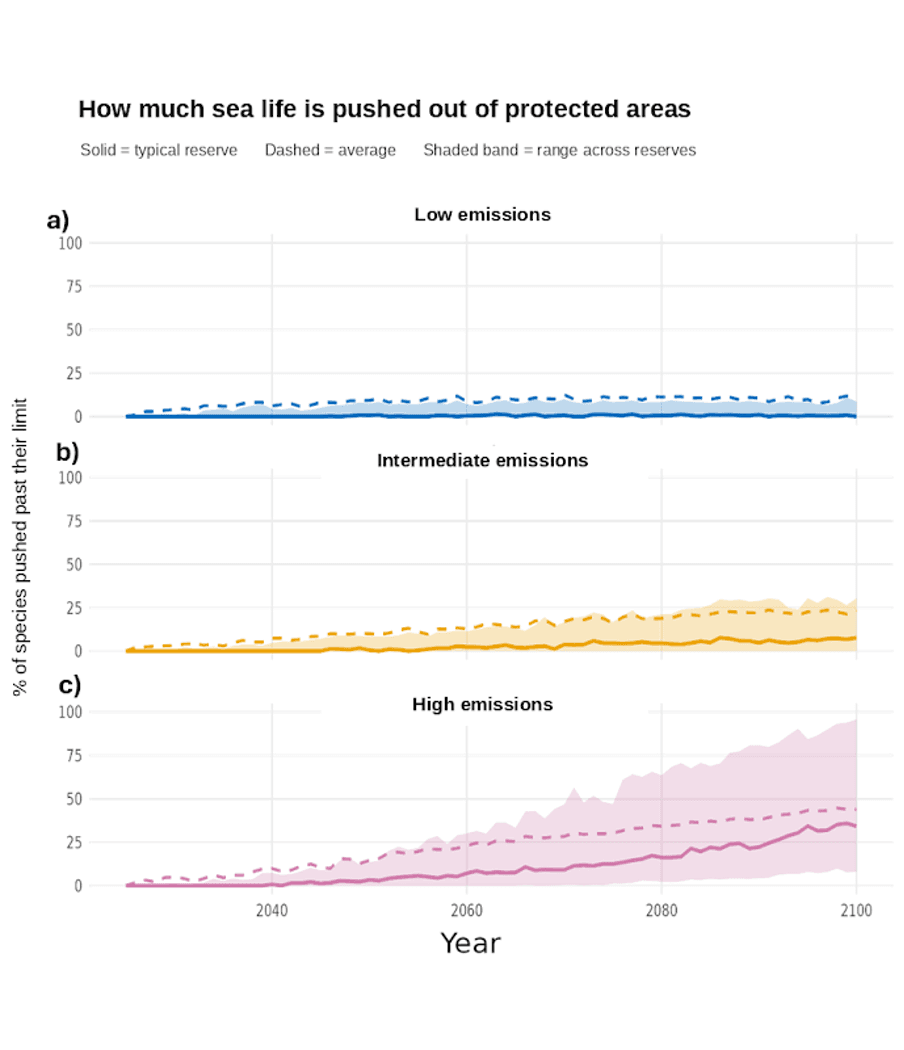
Fig. 2. The more we emit, the more sea life is pushed out. Each panel shows the share of species facing water too warm to survive inside protected areas, from now to 2100, under a low-, intermediate-, and high-emissions future. Under low emissions the losses stay close to zero. Under high emissions they climb steeply, approaching half of all species by the end of the century.
How to read this: the solid line is the typical reserve. The dashed line is the average across all reserves: it sits higher because a handful of badly hit reserves pull it upward. The shaded band shows how much reserves differ from one another: the wider it grows, the more unequal the damage.
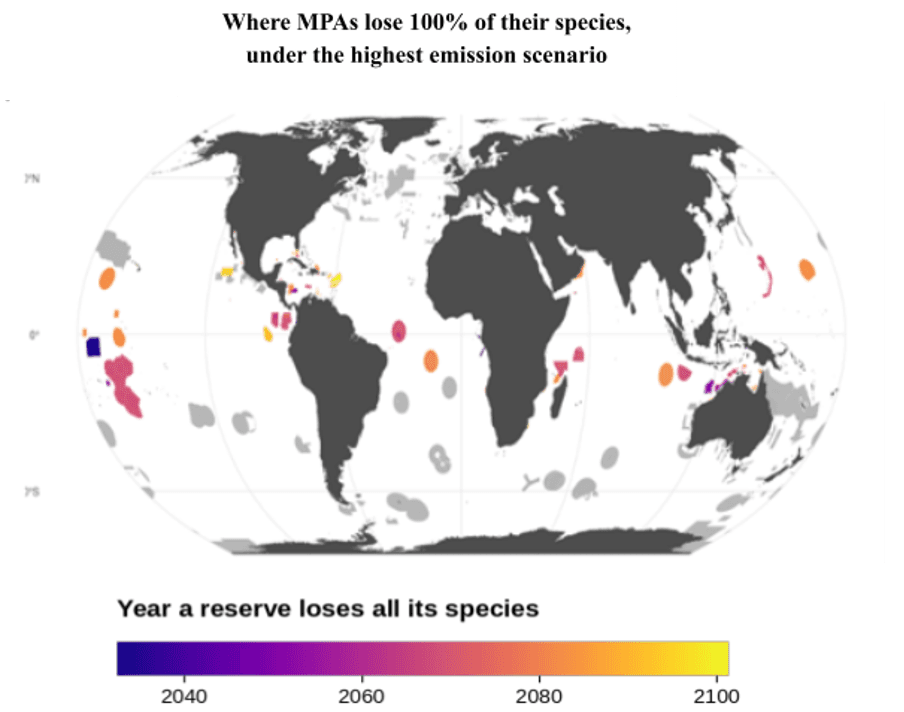
Fig. 3. Total loss: where every species is pushed out. Each coloured patch is a marine protected area projected to lose all of its species to heat under a high-emissions future, with the colour showing when it happens, from sooner to later . The losses cluster in the warm tropics and subtropics. the places hit first and hardest. Grey patches are reserves that don't cross into total loss this century.
The responsibility falls on us, as an intelligent species capable of making paradigm altering decisions
We’re currently not on track and headed for disaster. Improvement in these conditions will depend on immediate, drastic cuts to global emissions, the kind today's policies come nowhere near delivering. The trajectory we are following is the high-emissions one, and nothing we do now buys back what is already lost. However, there is still some hope that we can salvage what is left.
That is a bleak reality and a burden for us to carry, but still a choice that is ours to make. That choice isn't made by scientists or governments alone. One person changing their habits can feel like a drop in the ocean; however, enough of them together drive momentum that forces markets and governments to move, forming the ocean itself. The reef off that tropical coast is still doing everything we asked of it, the only question left is whether we will do the same, to mitigate the warming oceans while it still makes a difference.
The oceans have sent us a warning about temperature, and the numbers are clear. Right now, we are choosing not to read it, and this needs to change.
This article is based on my own research, from my dissertation "Static Protection in a Warming Ocean: Climate-Driven Loss of Thermal Suitability in Marine Protected Areas" (University of Southampton, 2026). The figures are adapted and simplified from that work for a general audience. The underlying analysis draws on global marine species records (OBIS, via Chaudhary et al. 2021), historical ocean temperatures (World Ocean Atlas) and future climate projections from the CMIP6 models used by the IPCC.
References:
Explore More
Take Climate Action
Simple, practical ways to reduce your carbon footprint, alone or with others.
10 Highest-Impact Climate Actions
The personal actions that make the biggest measurable difference, backed by science.

Join the Climate Action Movement
How individual actions add up to collective, global change.