What is a Carbon Footprint - And Why Does it Still Matter?

In short
In this post, we break down the different layers of what a carbon footprint actually means, from the misleading government figure to the complete picture, and explain how The Climate App has made this calculation meaningful for people in over 250 countries
In this post, we break down the different layers of what a carbon footprint actually means, from the misleading government figure to the complete picture, and explain how The Climate App has made this calculation meaningful for people in over 250 countries.
You can also download The Climate App's 'Full CO₂e Carbon Footprint by Country (2025) and Methodology' spreadsheet at the bottom of this blog.
You may have heard that the personal carbon footprint was invented by the fossil fuel industry. That's partly true: BP popularised the concept around 2004, rolling out a carbon footprint calculator as part of a marketing campaign widely seen as an attempt to shift responsibility from corporations to individuals. It worked, at least partially. For years, the idea of measuring your emissions while oil companies continued drilling felt like a distraction at best, and manipulation at worst.
But here's the thing: dismissing the personal carbon footprint entirely throws away one of the most powerful tools we have for understanding our own impact on the planet. The fact that a corporation tried to weaponise an idea doesn't make the idea wrong. Knowing your footprint isn't an admission that climate change is your fault. It's the beginning of informed, intentional action.
And individual action matters more than we're often told, not just for the direct emissions it reduces, but for what it signals. When people understand their impact and start making different choices, they bring those conversations into their workplaces, their communities and their politics. Cultural change and policy change don't happen separately. They feed each other. Hence, knowing your footprint is acknowledgement that we all influence the world around us, and that meaningful change comes from collective action built on individual awareness.
What actually is a carbon footprint?
A carbon footprint measures the total greenhouse gases produced by your lifestyle, but it's broader than just carbon dioxide. It includes methane (released by livestock, landfill and gas leaks), nitrous oxide (from agriculture and fertilisers), and a range of industrial fluorinated gases. Because these have very different warming effects, scientists convert them all into a single number using a unit called CO₂ equivalent, or CO₂e.
Why does this matter? Because methane, a significant contributor to emissions from beef production, has over 80 times the warming effect of CO₂ in a 20-year span. If we only counted carbon dioxide, we'd be dramatically underestimating the impact of food, and dramatically overstating the benefit of switching from petrol to electric without changing diet. CO₂e gives us the complete picture.
Why the number your government quotes is misleading
The UK government typically reports a figure of around 4.5 tonnes of CO₂ per person per year. You might have seen this quoted in news articles or political speeches as evidence of climate progress. It sounds almost manageable.
The problem is what it doesn't include. That figure is calculated on a territorial basis: it only counts emissions that physically occur inside the UK's borders. It excludes everything that the UK imports: the phone manufactured in China, the T-shirt made in Bangladesh, the beef raised in Brazil. Since the UK has spent decades de-industrialising and offshoring its manufacturing, this accounting method flatters the figures considerably.
A more honest measure is the full consumption-based footprint, which follows emissions to wherever they were caused on your behalf, whether that's in Shenzhen or São Paulo. It also includes your share of the public services your country provides for everyone. On this basis, the real UK footprint is closer to 11 tonnes per person. More than double the official figure.
Your footprint should reflect everything your life causes to be emitted, including what's made abroad on your behalf, and the shared services your country provides for you. That's the number that actually tells you something useful.
The three layers of a carbon footprint
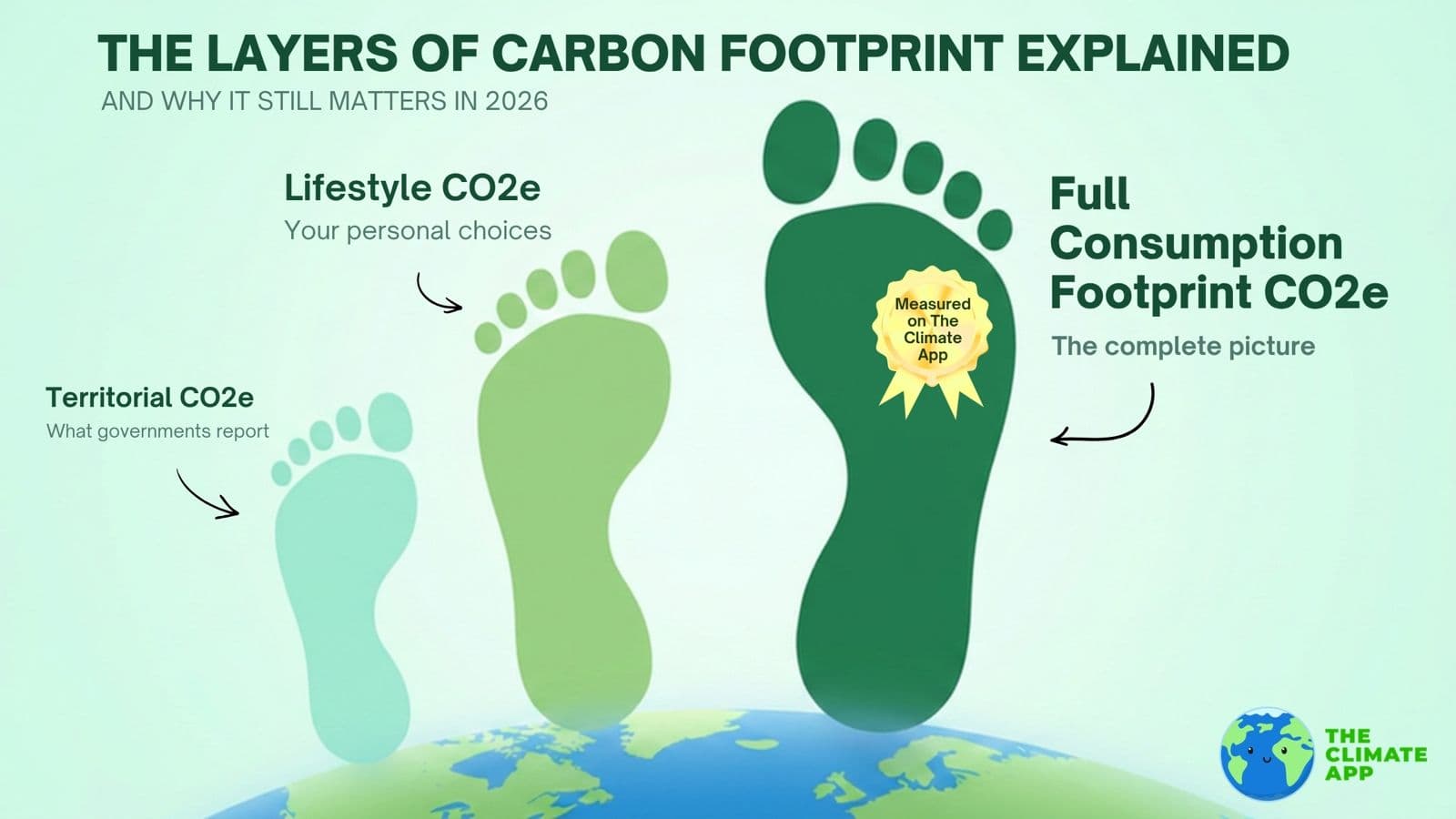
It helps to think of a carbon footprint as having three layers, each one more complete than the last.
The first is the territorial CO₂ figure, which is what governments report, and appears in international league tables. For the UK this is around 4.5T. It's useful for tracking national industrial emissions but tells you little about individual responsibility.
The second is the lifestyle CO₂e, the greenhouse gases directly and indirectly caused by your personal choices: what you eat, how you travel, how you heat your home, what you buy. For the average UK resident this is around 7.8T. Crucially, this is the portion you can actually influence through your behaviour.
The third is the full consumption footprint, which is the most complete picture. It takes your lifestyle emissions, adds the greenhouse gases embedded in imports from abroad, and includes your allocated share of collective public services: the NHS (healthcare), roads, schools, government and the military. For the UK, this brings the total to around 11T per person.
The Climate App works with your full consumption footprint, and also calculated for every country. It's the most complete and honest picture of your impact, and the one we compare against country averages and global targets.
Where the numbers come from
Building reliable carbon footprint figures for every country in the world requires multiple sources, because no single dataset covers everything at the quality we need.
For most of the 250+ countries in the app, we draw on consumption CO₂ data from Our World in Data (sourced from the Global Carbon Project), and apply calibrated regional multipliers to account for non-CO₂ greenhouse gases such as methane and nitrous oxide. For the UK's full footprint figure specifically, we use Defra's authoritative consumption footprint dataset, confirmed by the ONS Environmental Accounts.
For 23 countries, including the UK, USA, Germany, France, Japan, India, Kenya and Brazil, we have an even more reliable source: direct lifestyle footprint studies from the Hot or Cool Institute, whose 1.5-Degree Lifestyles research represents the most rigorous bottom-up analysis of how people actually live and what that costs the planet. These countries provide our highest-confidence anchor points.
We're transparent about the limitations. For smaller or data-scarce countries, we use estimated values based on income level, energy mix and regional comparators. The methodology is documented openly, and we continue to refine it as better data becomes available.
You can explore the full methodology and data by downloading our complete country-by-country dataset below.
📥 Download: Full CO₂e Carbon Footprint by Country (2025)
How The Climate App calculates your footprint
The Climate App's carbon footprint calculator was developed with the help of a small team of experts, led by Dr Arky Matsekh, climate scientist, Dr Matthew Sawyer, sustainability analyst and physicist Samuel Naef. Their input ensured the underlying methodology is grounded in current climate science and reflects the most credible available data for each country.
When you complete the initial survey, the app asks about six main areas of your life: your diet, flying, driving, home energy use, the size of your home, and how many people you share it with. Each answer is mapped to a calibrated emissions value for individual actions and behaviour, based off highly detailed UK government data as the baseline.
The app then applies a country-specific conversion factor. This reflects the fact that the same answer means very different things in different places. A diet that included meat 3-5 days per week in the UK implies UK farming, UK supply chains and UK food transport. The same answer in Afghanistan implies an entirely different food system with a fraction of the emissions. Food, home energy and lifestyle choices all scale with your country.
Some things don't scale. Flights and driving are based on physics: burning a litre of petrol releases the same CO₂ in London as it does in Lagos. These stay fixed regardless of where you live*.
On top of your survey answers, the app adds a static amount representing the lifestyle categories the survey doesn't (yet) ask about, such as shopping, leisure, clothing and financial services, plus your share of your country's public services. Together, these give you your full consumption CO₂e per capita: the most complete, comparable measure of your annual carbon impact.
How does your number compare?
Here's the context that makes your full consumption CO₂e per capita footprint meaningful:
Most people in developed countries need to reduce their footprint by 70–85% over the next decade to stay within a 1.5°C pathway. That's a confronting number. But it's confronting because our entire infrastructure, including energy systems, food systems and transport networks, was built around fossil fuels over more than a century. The gap between where we are and where we need to be is a systems problem, not a personal failing.
What you can actually do with this number: Turning awareness into action
The lifestyle portion of your footprint (food, travel, home and goods) is genuinely within your control. The public services portion requires collective action: voting, advocacy, the conversations you have at work and in your community.
In The Climate App, we don't ask you to overhaul your life overnight. We recommend starting with a 10% reduction in your footprint. That might sound modest, but if every user of The Climate App reduced their footprint by 10%, the cumulative effect would be significant, and more importantly, the conversations those reductions spark have an outsized impact on the culture around us.
Every individual who acts becomes a visible signal to the people around them. Every company that sees its employees engaged with climate starts to feel pressure to act. Every politician who hears constituents talking about their carbon footprint knows the issue has moved from abstract concern to everyday conversation. Small personal changes, scaled across millions of people, become the pressure that drives the systemic change we actually need.
Why this still matters
The fossil fuel industry helped popularize the idea in a way that shifted attention away from corporate responsibility. We can use it differently: as a tool for understanding rather than guilt, and for action rather than paralysis.
Your number isn't a verdict on who you are. It's a starting point. And starting points matter, because you can't change what you don't measure.
As founder of The Climate App, I think of it as 'Changing our internal world to create the external world we want to see.' So the app exists to make that change measurable, achievable and communal, because none of this works if we do it alone.
Every tonne reduced, or conversation sparked, helps limit the worst effects of what's coming. Every action is so important, and should be applauded. And the world you help build by reducing yours is one that's safer, fairer and more worth living in, for everyone. I hope you join us all on The Climate App.
📥 Download: Full CO₂e Carbon Footprint by Country (2025)
Sources: Hot or Cool Institute 1.5-Degree Lifestyles report (2021, updated 2025) · UNEP Emissions Gap Report 2023 · Defra Carbon Footprint for the UK and England to 2022 (May 2025) · Our World in Data / Global Carbon Project · Paris Agreement / IPCC AR6 · ONS Environmental Accounts *Future updates will include country-specific blends of fuel, such as Indias use of E20 blend involving the sugarcane industry
Explore More

Take Climate Action
Simple, practical ways to reduce your carbon footprint, alone or with others.
10 Highest-Impact Climate Actions
The personal actions that make the biggest measurable difference, backed by science.

Join the Climate Action Movement
How individual actions add up to collective, global change.